
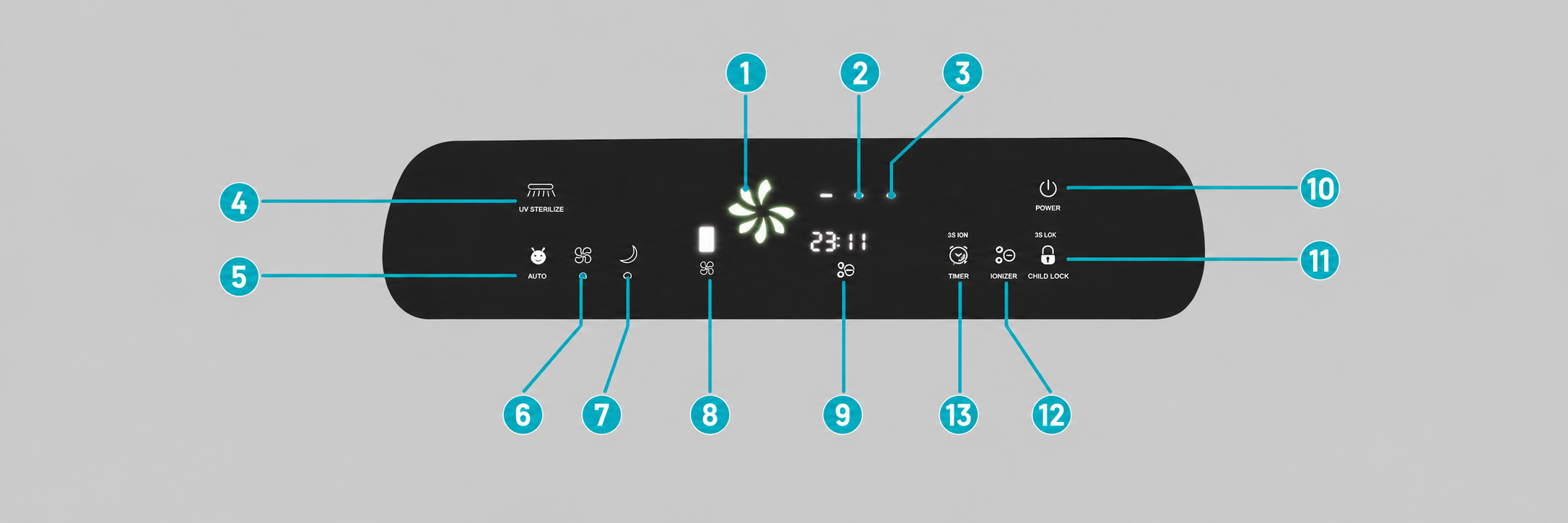
Air purifier sensor lights give a quick visual estimate of the air around the unit, but green, yellow, orange, red, and blue do not have one universal meaning. Each manufacturer defines its own colour ranges, sensor behaviour, and update speed. To use the display correctly, check the manual, understand what the sensor actually measures, and watch the numerical trend when the model provides one.
What Do Air Purifier Sensor Colors Measure?
Many home air purifiers use an optical particle sensor. Air passes through a small sensor chamber, where light scattering helps the device estimate the concentration of airborne particles. Some units focus on PM2.5, while others combine particle readings with dust, odour, gas, or volatile-organic-compound estimates.
The colour is a simplified interpretation of that measurement. It is designed to be easy to understand at a glance, but it does not identify the pollutant source or provide a complete health assessment. A green light can mean the measured pollutant is low according to the product’s threshold, not that every aspect of the room is ideal.
Common Air Quality Indicator Colors
| Common colour | Typical interpretation | What to do |
|---|---|---|
| Blue or green | Lower measured pollution | Keep normal operation and continue source control |
| Yellow or orange | Moderate increase | Check recent activities and increase fan speed if needed |
| Red or purple | Higher measured pollution | Identify the source, ventilate when outdoor air is suitable, and run filtration |
These descriptions are only general patterns. Your model may use different colours or thresholds. Always use the official manual as the authority for a specific appliance.
Why Does the Light Change Suddenly?
Cooking
Frying, grilling, toasting, and high-temperature cooking can release fine particles and droplets. A sensor in a nearby living area may change colour even when smoke is not clearly visible. Use kitchen exhaust that vents outdoors, cover pans when practical, and avoid overheating oil.
Cleaning and Sprays
Aerosol cleaners, fragrance sprays, alcohol products, and dust disturbed during sweeping can trigger particle or gas sensors. This does not automatically mean the purifier is malfunctioning. Reduce the source and ventilate according to product instructions.
Outdoor Pollution
Traffic, smoke, haze, construction, and outdoor burning may enter through windows and gaps. If the light changes at similar times each day, compare the pattern with outdoor activity. Close openings temporarily when outdoor pollution is high, then ventilate when conditions improve.
Humidity and Steam
Fine water droplets can scatter light and may affect some optical sensors. Steam from cooking, bathing, or a humidifier can therefore cause a temporary increase. Keep the purifier and monitor away from direct mist and use a dehumidifier when persistent moisture is the actual problem.
Why Does the Indicator Stay Red?
A persistent red indicator can mean the pollution source continues, the purifier is too small for the room, airflow is obstructed, the filter is overloaded, or the sensor needs cleaning. Start by removing obvious sources. Then check that the inlet and outlet have clear space and that doors or open areas are not making the effective room much larger.
- Inspect the filter and replace or clean it according to the manual.
- Clean the sensor opening only as directed by the manufacturer.
- Move the purifier away from walls, curtains, furniture, and direct steam.
- Run a higher fan speed and allow enough time for multiple air changes.
- Check whether outdoor air is continuously bringing pollution inside.
Why Does It Turn Green Too Quickly?
A green light shortly after startup may be accurate near the sensor but not representative of the entire room. If the purifier sits in a corner with limited circulation or if the sensor is close to the clean-air outlet, it may sample cleaner air than occupants breathe elsewhere.
Compare the built-in display with a separate monitor positioned several feet away. Also remember that a particle sensor will not necessarily respond to carbon dioxide, every odour, or every gas. Filtration and ventilation address different indoor-air problems.
Does Auto Mode Respond to the Sensor?
On many air purifiers, auto mode uses the sensor reading to raise or lower fan speed. When the indicator detects more pollution, the fan increases; when the reading improves, it slows down. This can balance cleaning, noise, and power use.
Auto mode is convenient, but a low speed may not provide enough continuous filtration for every situation. During smoke, cooking, cleaning, illness precautions, or a known outdoor pollution event, a manually selected higher speed may be more appropriate. Choose the fastest setting your household can run consistently.
How to Keep Sensor Readings Useful
Sensor accuracy depends on maintenance and placement. Dust can accumulate around the inlet, and direct sunlight, condensation, or strong airflow may affect readings. Follow the device instructions instead of inserting objects or applying liquid cleaner to the sensor.
- Place the purifier in an open position within the occupied room.
- Keep sensor openings free from dust and obstruction.
- Use the correct replacement filter and reset the filter indicator after changing it.
- Watch trends over time rather than reacting to every momentary colour change.
- Investigate repeated spikes by noting what was happening in the room.
Frequently Asked Questions
Does a red light mean the filter is dirty?
Not always. The air-quality light and filter-replacement light may be separate indicators. Check the symbol and manual before replacing the filter.
Why does perfume change the sensor colour?
Perfume may release droplets and volatile compounds. Depending on the sensor type, the purifier may interpret these as a rise in particles or gases.
Can I trust the colour without a number?
It is useful for trends, but a numerical display gives more detail. The colour alone should be combined with the manual, room activities, and proper maintenance.
Why does the indicator differ from a separate monitor?
Devices may use different sensors, calibration, thresholds, sampling intervals, and positions. Compare trends at the same location rather than expecting identical values.
Use Sensor Lights as a Practical Guide
Air purifier colours are most useful as an early signal. When the light changes, look for the source, choose the right response, and confirm that the level falls. With good placement, regular maintenance, and an appropriately sized UV Care air purifier, the sensor becomes a helpful part of a consistent clean-air routine.